Inequality Grid Logic Challenge
Reviews
Inequality Grid Logic Challenge is best suited to players who already enjoy Sudoku and want an additional reasoning layer rather than a new genre. Its strength is the way inequality signs force relative-value thinking alongside standard placement rules, and the difficulty levels control how densely those clues appear. The undo and hint tools lower frustration without solving the grid for you. The trade-off is that the interface and presentation stay deliberately plain — this is a logic exercise, not a visually elaborate one.
Description
Where Sudoku Meets Relational Clues
Inequality Grid Logic Challenge takes the familiar 9x9 Sudoku framework and adds a second rule set: inequality signs placed between certain adjacent cells. These signs specify which of the two neighbouring digits must be larger. A cell therefore has to satisfy three simultaneous demands — its row, its column, its 3x3 box, and any inequality relationship it shares with a neighbour. The result is a puzzle where absolute placement and relative value must be reasoned about together.
Reading the Grid and Entering Digits
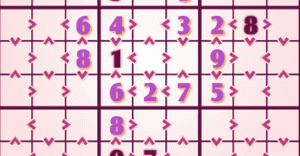
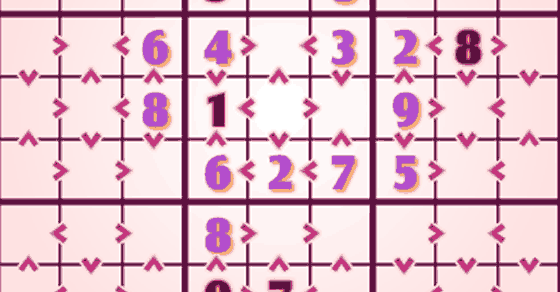
The interface stays deliberately plain. Players select an empty cell and assign a digit using on-screen controls. Inequality symbols sit between specific cell pairs, marking exactly where a comparison applies. Because those symbols are confined to the edges they describe, they do not clutter the grid or hide the digits already placed. [IMG_1]
Difficulty That Scales With the Clues
Multiple difficulty levels change how many inequality signs appear and how tangled their relationships become. Easier puzzles use fewer comparisons or simpler ones, letting newcomers absorb the extra rule before it is pushed hard. Harder puzzles multiply the relational clues, so a single digit choice can ripple through several chained inequalities at once. That progression is the main lever the game uses to move from approachable to demanding.
Tools That Assist Without Solving
An undo function reverses recent entries without penalty, which matters when a misplaced digit invalidates a chain of inequality reasoning. A hint system offers either a correct digit or a highlighted inequality relationship. Neither tool removes the need to work out the logic — they nudge rather than complete.
How Experienced Solvers Approach It
Cells touched by several inequality signs are usually the most productive starting points, because each sign narrows the candidate digits. From there, solvers track possible values per cell and cross-check them against row, column, and box requirements. Scanning for patterns that satisfy both the placement rules and the greater-than relationships becomes the core loop as difficulty rises. Regular practice is the stated route to faster, more accurate solving.








Editorial Notes