Merge Arena: Rainbow Friends
Reviews
Merge Arena: Rainbow Friends succeeds by keeping its input simple and pushing complexity into the merge decision. Dragging identical characters together is easy to grasp, but choosing which pairs to combine, and when to hold out for a better evolution, gives the game more depth than its hyper-casual label suggests. Automatic battles keep rounds quick and readable. The offline mode and free-to-play structure make it accessible, while optional boosts and regular updates provide room for dedicated players. It is best suited to players who enjoy light strategy in short sessions rather than direct combat control.
Description
The Merging Mechanic
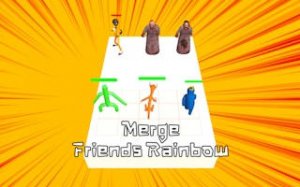
Merge Arena: Rainbow Friends centers on a single, repeatable action: dragging two identical characters together on the battlefield. When they connect, they combine into one stronger friend with new abilities. That result is the engine of everything else. You start by picking a first set of rainbow friends, then immediately face the decision of which pairs to merge and which to leave alone. Because each merge consumes two characters to produce one, every move trades quantity for quality. The game rewards players who think a step ahead rather than merging whatever is closest.
Arena Battles and Automatic Combat
Once merged, your friends fight automatically in arena battles. You do not control individual attacks or issue commands during combat. Instead, your influence comes before the fight, through the team you have assembled. This design keeps matches fast and readable, and it makes the merge phase the real strategic layer. Watching battles also serves a practical purpose: it shows which merged forms hold up against certain opponents, which in turn informs your next round of merging.
Progression and Challenge Curve
Rounds grow tougher as you advance, so a team that worked earlier may not survive later. Completing challenges unlocks new friends and reveals rare combinations, giving you more options to experiment with. The difficulty curve is gentle at first, then asks for more deliberate planning. You are not just merging to survive the current round; you are building toward combinations that can handle what comes next. That tension between immediate survival and long-term team building is what gives the game its staying power.
Controls, Access, and Audience
Controls are limited to tapping to select and dragging to merge, which makes the game immediately understandable to players of any age. Bright, cheerful art and sound effects support the family-friendly tone. The game is free to play with optional in-game boosts, and it supports offline play, so progress does not depend on a constant connection. Regular updates add new friends and challenges, extending the roster over time. Casual players can enjoy short sessions, while dedicated players can refine merge order and timing.









Editorial Notes