Crystal Path Tile Puzzle
Reviews
Crystal Path Tile Puzzle keeps its rules minimal: clear groups of four to six matching tiles, reveal a treasure, then open a route for the miner. The two-phase structure gives each level a clear arc, and the falling-tile behavior adds just enough depth to reward planning. Bright visuals and the lack of a timer suit players who prefer thoughtful, low-pressure puzzling, though anyone seeking fast action or competitive scoring will find it too gentle.
Description
Matching Groups of Four to Six
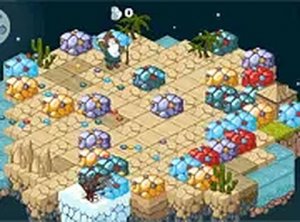
Crystal Path Tile Puzzle is built around a single repeated decision: which connected group of identically colored tiles to remove. Clicking or tapping a set of four, five, or six tiles clears them from the board. Larger groups score more and free up more space, so random clicking rarely beats deliberate selection. After each successful match the board resets into a new arrangement, which means the pattern you just solved is gone and the next one has to be read from scratch.
Two Goals Per Level
Every level runs in two phases. First, matching tiles gradually reveals a hidden treasure somewhere on the board. Once that treasure is collected, the objective changes: you must clear a continuous route of tiles so the miner can walk safely to his cottage. The shift matters because the first phase rewards broad clearing, while the second demands a connected path rather than scattered matches. Each level uses a different board layout, and later arrangements grow more complex, so planning ahead becomes more important than speed.
Reading the Board and Chain Reactions
Matches near the bottom of the board can make tiles above them fall, and those falls sometimes line up new groups that clear large areas at once. Recognizing where a fall will land is the main skill the game asks for. Because there is no timer, players can study a layout, test an approach, and adjust without penalty. The trade-off is that a careless match can scatter the tiles you needed for the path phase, so the best moves are usually the ones that serve both goals at once.
Presentation and Platform
Bright colors and simple character designs keep the board readable, and smooth animations give immediate feedback for every match. Sound effects stay light and do not interrupt concentration. The game runs entirely in a web browser with no installation or account, and it supports both touch and mouse input across phones, tablets, laptops, and desktops. The interface adapts to different screen sizes, and the absence of time limits makes it practical for either a short break or a longer session.






Editorial Notes