Strategic Tic-Tac-Toe Board Puzzle
Reviews
Strategic Tic-Tac-Toe Board Puzzle takes a game everyone knows and adds a layer of positional thinking that feels fresh. The linked-board mechanic means every move has consequences beyond the current square, which rewards foresight and adaptability. It is easy to teach but offers enough depth for repeat play. The main limitation is that the experience depends heavily on having a thoughtful opponent; against a careless player, the strategic tension fades. Still, for puzzle fans and families looking for a quick mental challenge, it delivers solid value.
Description
Nine Boards, One Objective
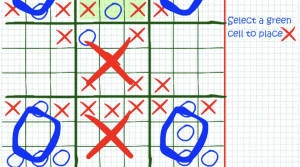
The game replaces the familiar single grid with nine small tic-tac-toe boards set inside a larger three-by-three layout. Your goal is not to win any single small board but to claim three small boards in a row—horizontally, vertically, or diagonally—on the big board. That shift in scale changes every decision: a move that wins a small square can also hand your opponent a strategic opening elsewhere.
How Each Move Directs the Next
What separates this from standard tic-tac-toe is the linking rule. When you place your mark in a cell of a small board, that cell's position determines which small board your opponent must play in next. For example, marking the top-right cell sends your opponent to the top-right board. If that board is already won or completely full, the next player may choose any available board. This constraint forces you to think beyond the current square and consider where your move will send your rival.
Planning Under Pressure
Because every placement redirects play, the game rewards players who look several moves ahead. You are not just trying to complete a line; you are trying to steer your opponent into boards where you already hold an advantage. Controlling the center board early is often useful because it sits at the intersection of multiple winning lines. Adaptability matters too, since a single unexpected move can shift the flow of the entire match.
Who It Suits
The rules are simple enough for beginners and families, yet the layered decision-making appeals to puzzle solvers and strategy fans. Sessions can be short or extended, depending on how much time players want to invest. The clean interface keeps attention on the board rather than on distractions. Whether you play solo or against another person depends on the version you choose, but the core challenge remains the same: outthink your opponent across nine interconnected grids.






Editorial Notes